● SERVICES / Keyword research & strategy
Don't chase keywords — understand the demand behind them.
Keyword Research Services in Delhi NCR aren’t about building long keyword lists. They’re about understanding customer intent, identifying commercial opportunities, and creating an SEO roadmap that supports sustainable business growth.
- Intent over volume
- Revenue-aligned roadmap
- Yours to keep
● the reframe
More keywords aren’t the point
Most keyword reports stop at “here’s a spreadsheet of 4,000 terms.” That’s not strategy — that’s a starting point at best, and a distraction at worst.
Toriva’s job is to do the harder, more honest work that follows: which of those terms are real, which are worth pursuing, and how the answer changes what you build next.
01
Common pitch
Find more keywords.
02
Common pitch
Chase high search volume.
03
Common pitch
Optimize for whatever ranks easiest.
04
Common pitch
Treat each keyword as a target.
What we actually do
Find the right ones — the rest is noise.
What we actually do
Pursue high-intent demand. Volume without intent is empty traffic.
What we actually do
Optimize for what would actually pay you back if it ranked.
What we actually do
Treat each topic as a customer question that deserves a real answer.
● The intent spectrum
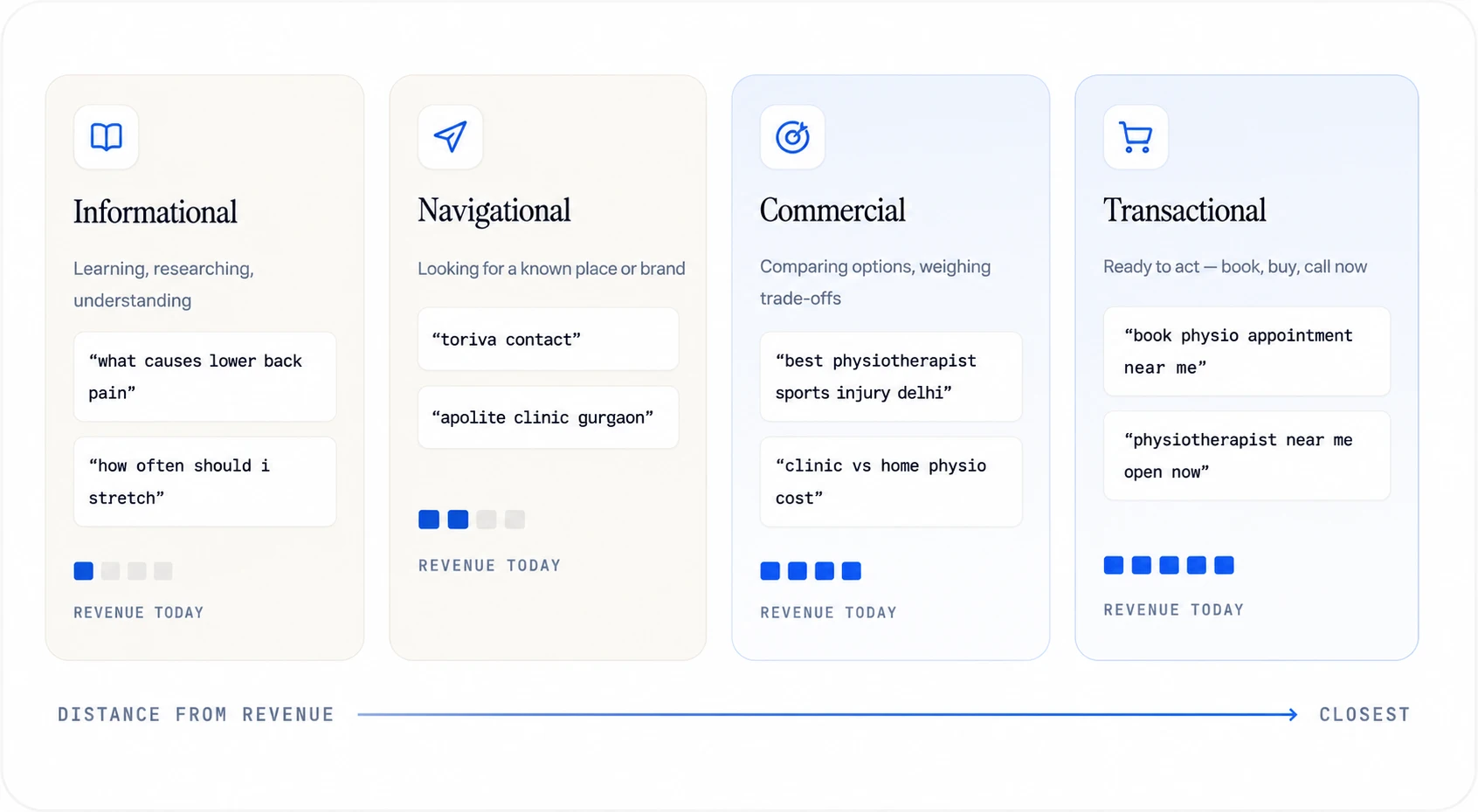
Four kinds of search
Two pay the bills
Every search a customer makes sits somewhere on this spectrum. Knowing where a query falls tells you whether it deserves a blog post, a service page, a product page — or nothing at all.
01
Most agencies overload the left.
Informational keywords are easy to rank for and impressive in reports — but they convert poorly without a deeper funnel beneath them.
02
We start from the right.
Transactional and commercial queries fund the rest. We map those first, then build informational layers that feed them.
03
The shape of your universe matters.
A keyword universe top-heavy with research queries is a content factory. One anchored on commercial intent is a sales channel.
● The keyword universe
Not a list -
an ecosystem.
We don’t deliver spreadsheets. We deliver topic ecosystems — small clusters of related queries grouped around a central business theme, each cluster mapped to a specific page or content asset.
One pillar topic. Several supporting clusters. Each cluster builds authority for the pillar. The pillar pays the bills. The clusters earn the trust that lets it rank.
Pillar — your highest-revenue topic
Cluster — a supporting topic group
Query — an individual page or section
● The intent spectrum
Four kinds of search
Two pay the bills
Every search a customer makes sits somewhere on this spectrum. Knowing where a query falls tells you whether it deserves a blog post, a service page, a product page — or nothing at all.
● The roadmap
A year of work,
sequenced.
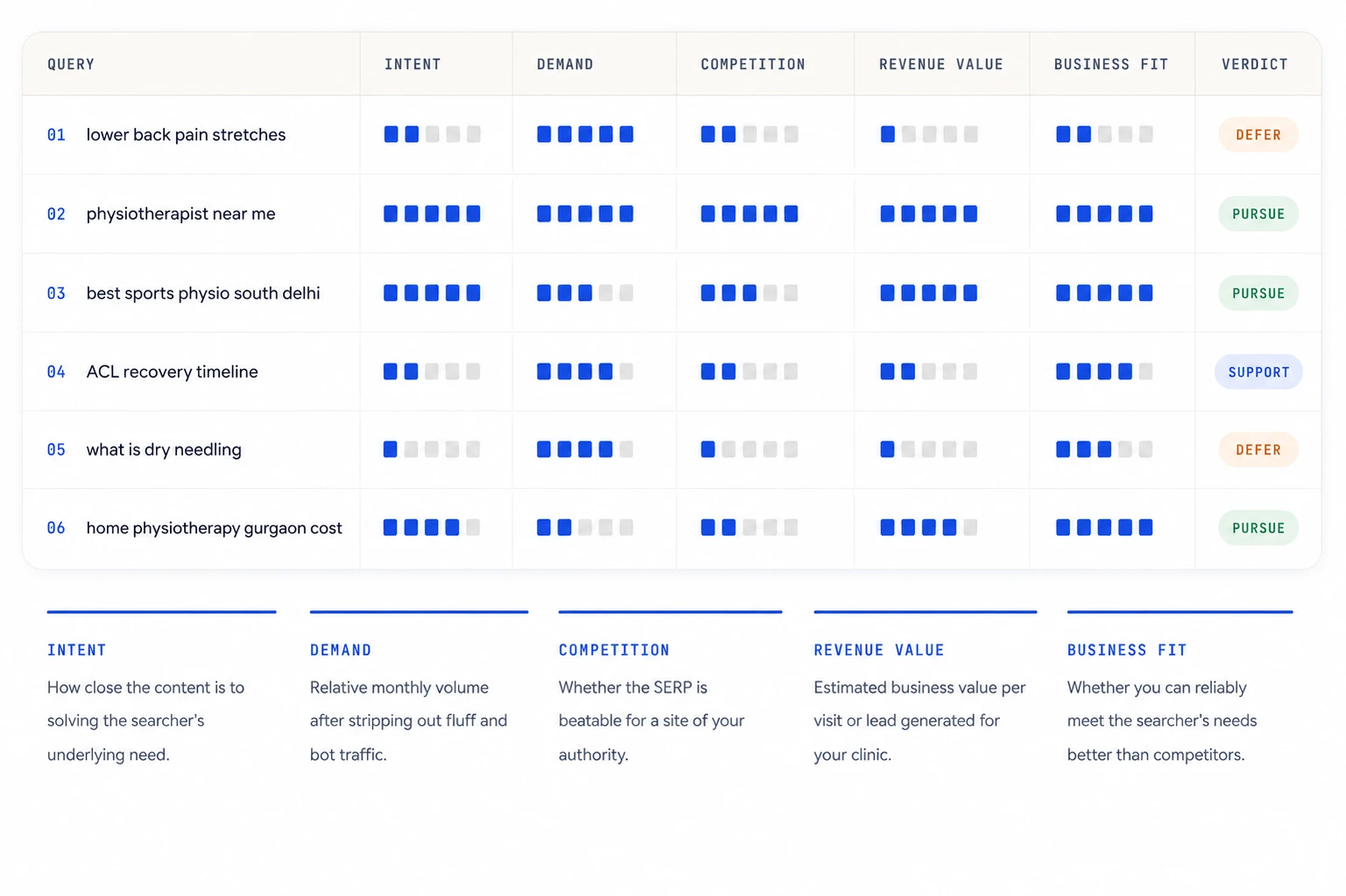
Once the universe is mapped and scored, we sequence the work into a quarterly roadmap. Revenue-closest pages first. Then the authority layer. Then depth. Then compounding. This is what a typical 12-month engagement looks like.
Foundation
High-intent transactional & local pages. The pieces closest to revenue, shipped first.
Sports physiotherapy · Delhi
Home physiotherapy · Gurgaon
Hauz Khas clinic
Clinic vs home physio cost
Authority
High-intent transactional & local pages. The pieces closest to revenue, shipped first.
Sports physiotherapy · Delhi
Home physiotherapy · Gurgaon
Hauz Khas clinic
Clinic vs home physio cost
Depth
High-intent transactional & local pages. The pieces closest to revenue, shipped first.
Sports physiotherapy · Delhi
Home physiotherapy · Gurgaon
Hauz Khas clinic
Clinic vs home physio cost
Compound
High-intent transactional & local pages. The pieces closest to revenue, shipped first.
Sports physiotherapy · Delhi
Home physiotherapy · Gurgaon
Hauz Khas clinic
Clinic vs home physio cost
● Competitor gap analysis
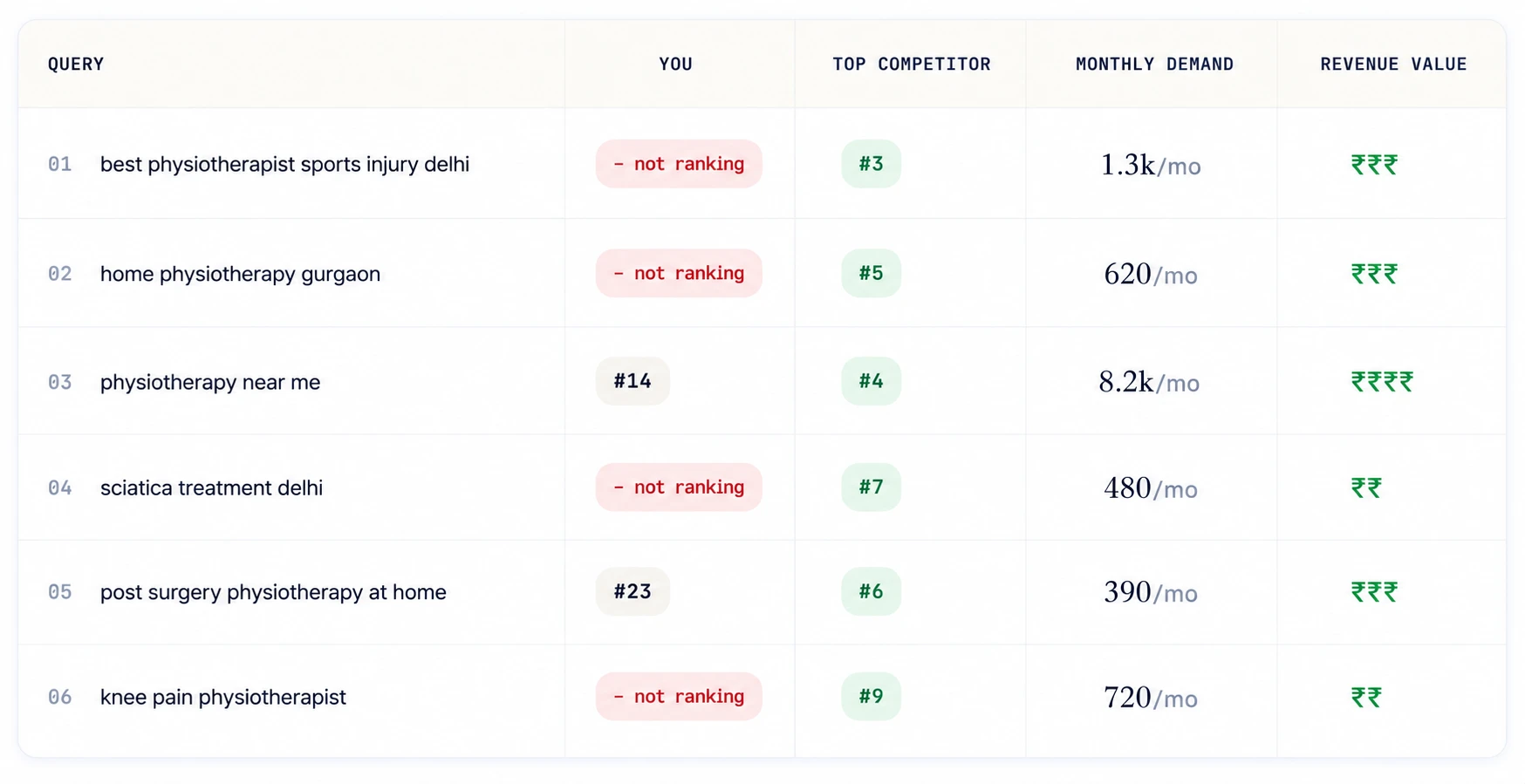
What they rank for and you don't.
Part of every engagement is a careful look at the two or three competitors customers actually compare you to. Here’s a small sample of what that looks like — the queries where they’re visible and you aren’t, sorted by what’s worth pursuing.
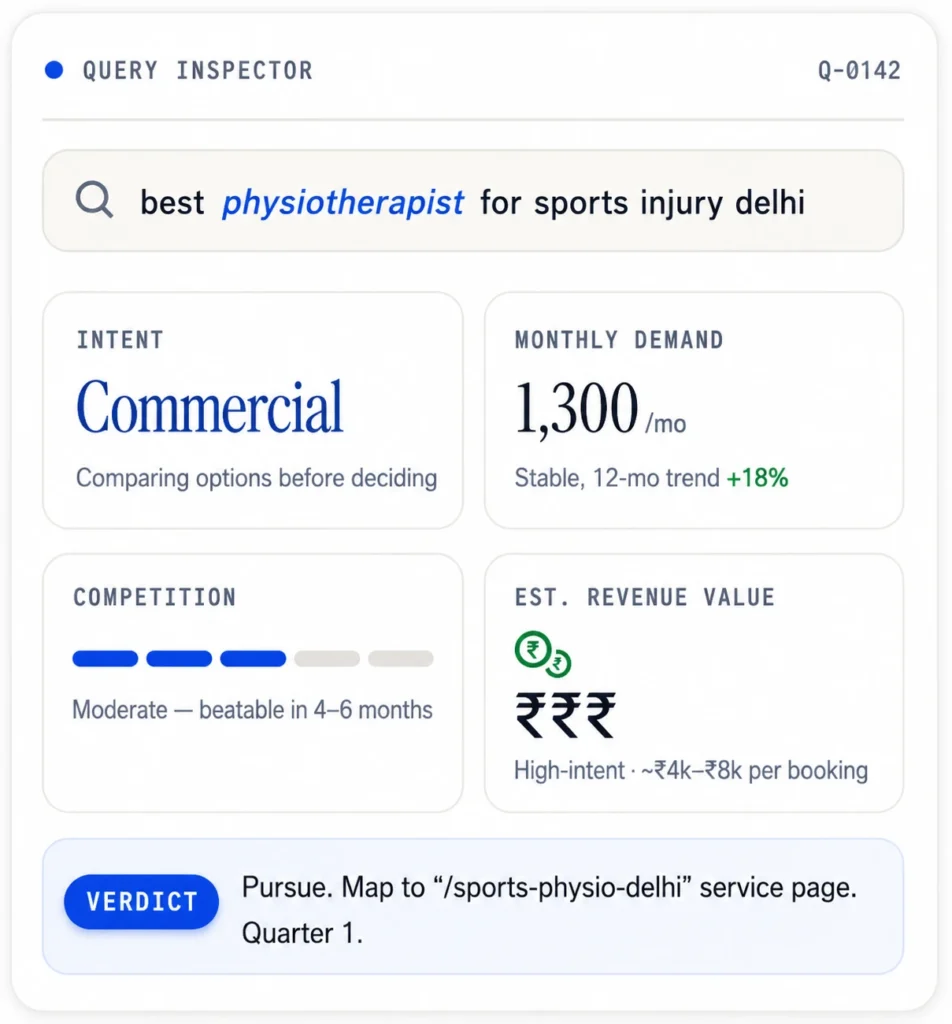
Every audit contains 20–40 findings written in this format. We never bury anything in attachments or footnotes — if it’s a finding, it has a page.
● The intent spectrum
Built with
industry-standard
tools.
We combine first-party analytics with professional SEO platforms to validate search demand, identify opportunities, and support data-backed recommendations.
● Before you ask
Honest answers about strategy
The questions every local business owner asks before investing in this channel — answered plainly, without sales-speak.
Why isn't this just a keyword research tool with a subscription?
Tools surface keywords. They don’t tell you which ones match your business model, which ones a site at your authority level could realistically win, or which ones share an underlying intent. That interpretation is the work — and tools can’t do it without someone who knows your business sitting in front of them.
How many keywords should I actually be targeting?
Far fewer than most reports suggest. A typical small or mid-sized business operates well with 30–80 carefully chosen primary queries, grouped into 5–10 topic clusters. More than that usually means dilution, not coverage.
What if my industry has very low search volume?
Low volume is usually compensated by high intent and high value per click. We model revenue per click rather than total search volume — a query with 60 searches/month and a ₹50k transaction value beats one with 6,000 searches/month and a ₹50 outcome.
Will you give me the raw keyword data?
Always. You get the full keyword universe, the scoring, the competitor data, and the roadmap — in editable formats. None of it is locked into a Toriva dashboard or held hostage.
How often should keyword research be revisited?
Once a year is the rhythm for most businesses — with a lighter quarterly check on the top 20–30 queries to catch shifts in intent, SERP features, or competition. Anything more aggressive is usually busywork.
Do you handle the content production after the research?
We can — but we don’t have to. The strategy is built to be implementation-agnostic. Your team, your existing agency, or a content partner can act on it. We’re happy to brief writers, review drafts, or stay hands-off, depending on how you prefer to operate.
What is Keyword Research?
Keyword research is the process of identifying the words and phrases people use when searching for products, services, or information online. It helps businesses understand user behavior and build effective SEO strategies.
Why is keyword research important for SEO?
Keyword research helps ensure that website content aligns with what users are actively searching for. This improves relevance, supports search visibility, and helps attract qualified organic traffic.
What is search intent?
Search intent refers to the reason behind a user’s search query. Users may be looking for information, comparing options, finding a local service, or preparing to make a purchase decision.
Get a free SEO snapshot of your
site — in 24 hours.
No pressure. No obligations. Just a practical discussion about where your business is today — and where it could realistically go next.
Founder replies personally · 24-hour response window · No sales sequence