SERVICES/TECHNICAL SEO

The quiet work that makes every other SEO investment actually pay off.

Our Technical SEO Services in Delhi NCR focus on the behind-the-scenes improvements that help search engines crawl, understand, and rank your website more effectively.

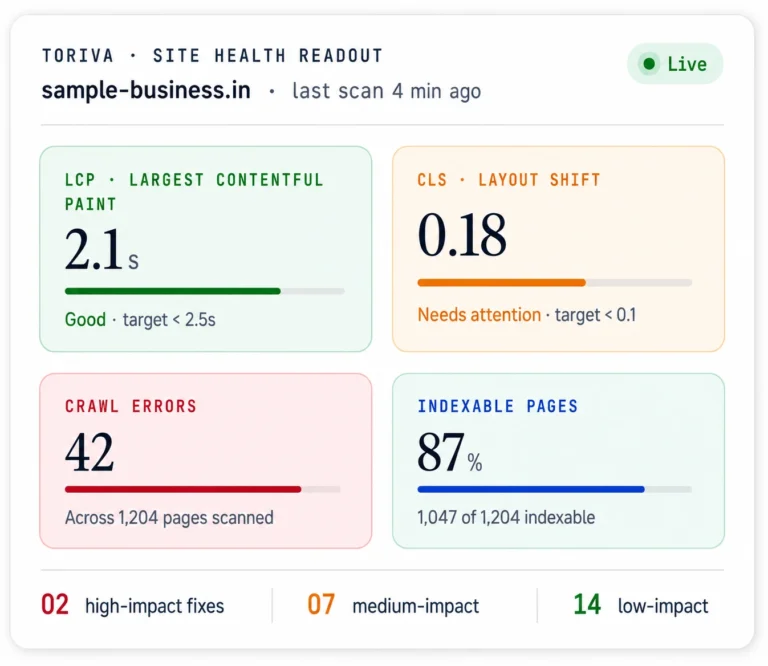
Technical SEO Services in Delhi NCR dashboard showing Core Web Vitals, crawl errors, layout shift, and indexable pages.

WHY IT MATTERS 

Everything else
sits on this.

People talk about SEO like it’s content and links. Both matter — but neither works on a site Google can’t crawl, render, or understand.

Technical SEO is the foundation underneath all of it. When it’s right, you barely notice it. When it’s wrong, every other SEO rupee you spend leaks out before it ever earns a return.
Layer 01 · The foundation

Technical foundation

Crawl · render · index · speed · structure

You are here

Layer 02

Content & relevance

Pages, intent, depth, topical coverage

Layer 03

Authority & reputation

Links, mentions, reviews, trust signals

● What we look at

Six lenses,
one read of your site.

Every technical audit runs through the same six lenses — applied in the same order. The output is a single prioritized read of your site, not six disconnected reports.

01

Crawl

  • Robots.txt directives
  • Crawl budget usage
  • XML sitemap completeness
  • Orphan & dead-end pages

02

Index

  • Indexable vs blocked URLs
  • Soft 404s and thin pages
  • Canonical signals & duplicates
  • Search Console coverage

03

Render

  • JavaScript rendering issues
  • Hydration & SSR behaviour
  • Critical content visibility
  • Lazy-loading correctness

04

Speed

  • Core Web Vitals (LCP, CLS, INP)
  • Image weight & formats
  • Server response time
  • Render-blocking scripts

05

Structure

  • Information architecture
  • Internal linking model
  • URL hygiene & consistency
  • Breadcrumb & hub design

06

Signals

  • Schema & structured data
  • Open Graph & metadata
  • Hreflang & localisation
  • Pagination & faceted nav

Symptoms & causes

If you're seeing this, it's
usually this.

What you're seeing

01

Traffic dropped after a redesign

02

Pages are indexed but get zero clicks

03

New pages take weeks to appear in Google

04

Search Console shows lots of ‘Discovered — not indexed’

05

Site feels fast on your laptop but PageSpeed shows red

06

Rankings move up and down for no clear reason

Most “SEO problems” reported by business owners are technical problems wearing a different label. Here’s a short translation guide — the symptom you’re seeing, and the technical root cause we most often find behind it.

What's usually causing it

Old URLs weren’t redirected — Google sees a brand-new site with no history.

Titles, descriptions, or rendered content don’t match search intent for the keyword you’re ranking on.

Crawl-budget waste — internal links, sitemap signals, or low-value URLs are diluting attention.

Either content quality is below Google’s bar, or your site’s authority isn’t carrying new URLs across the indexing line.

Google measures real-user Core Web Vitals from mobile — not your office Wi-Fi.

Often a rendering or canonical issue — Google can’t decide which version of a page is the real one.

How an engagement runs

Sequenced, not
scattered

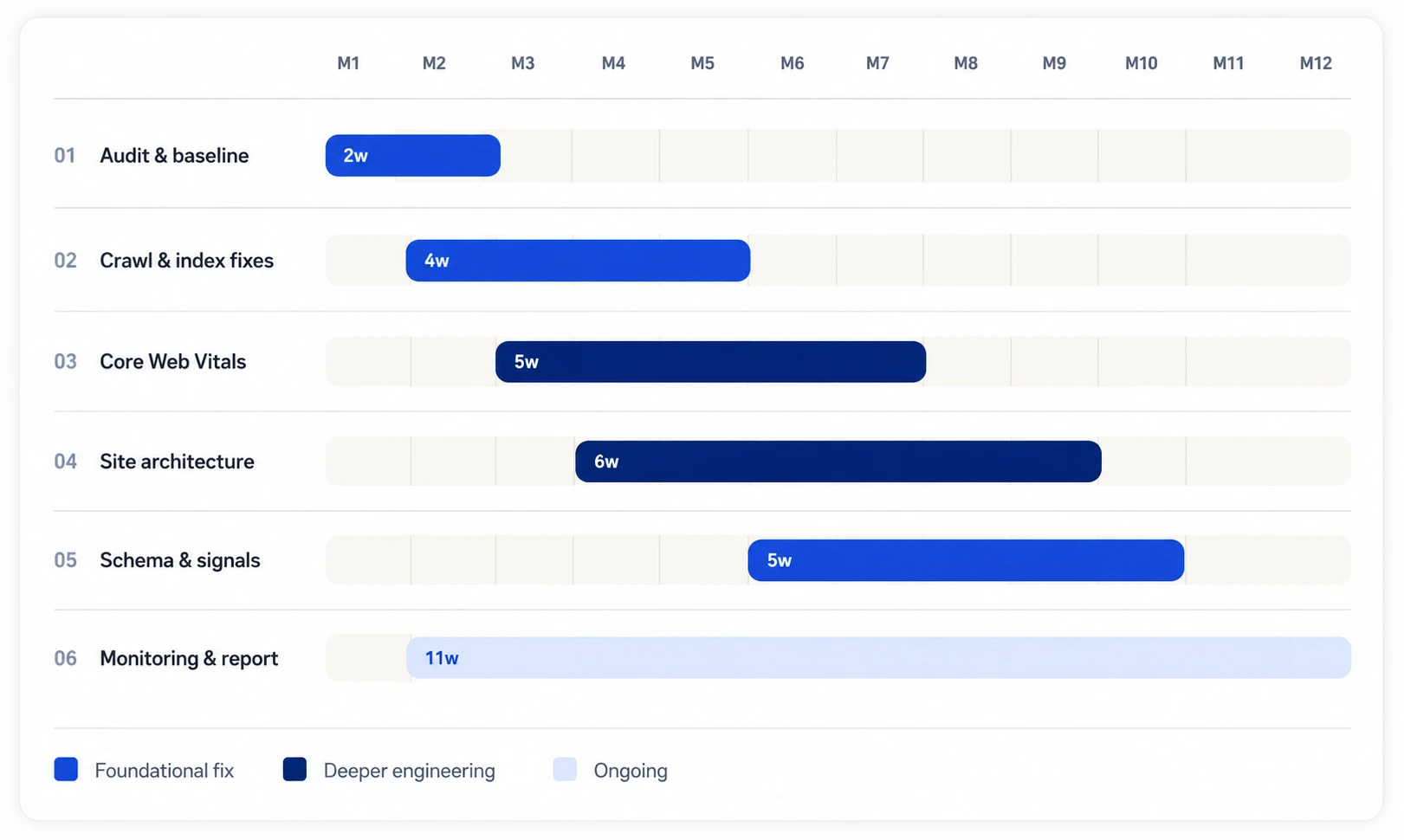
A typical 12-week technical engagement at Toriva — what gets worked on, when, and how the workstreams overlap. Real engagements adjust to what your audit surfaces; this is the shape they usually take.

Technical SEO implementation roadmap showing the sequence of audit, crawl fixes, Core Web Vitals, site architecture, schema optimization, and ongoing monitoring.

What it enables

The outcomes a
healthy site allows.

01

Outcome

More of your content actually ranks

02

Outcome

Search traffic survives redesigns and migrations

03

Outcome

Visitors don't bounce before the page loads

04

Outcome

New pages start ranking faster

05

Outcome

Rich results appear in search listings

06

Outcome

You spend less on SEO over time, not more

Technical SEO doesn’t create demand. But it removes every quiet friction between the demand that already exists and your site earning the credit for it.

Because

Crawl and indexing fixes let Google find, render, and trust pages it had been ignoring.

Because

Redirect maps, canonical hygiene, and URL discipline carry equity across the move.

Because

Core Web Vitals work — image weight, render-blocking scripts, and server response — keeps users and Google happy.

Because

A clean internal linking model and a tight site architecture pass authority where it belongs.

Because

Structured data and signals tell Google what your content is — and what it deserves to be shown as.

Because

Foundational fixes compound. Once they're done, future SEO investments work harder for the same money.

Where we draw the lineT

Practices we
refuse to ship.

Technical SEO has a long history of clever tricks. Most of them age badly. These are the lines we don’t cross — for your domain’s sake, and ours.

No hidden text, doorway pages, or cloaking

Every shortcut that’s worked short-term has eventually been penalized. We don’t gamble your domain on tactics with a known expiry date.

No schema spam

We mark up what’s actually on the page. Schema that misrepresents content gets ignored at best — and manually penalized at worst.

No bulk AI-generated thin pages

Indexing 5,000 thin location pages doesn’t help you rank. It dilutes everything that could.

No 'fix it and forget it' deliverables

Technical SEO is monitored, not shipped. Migrations break. Templates change. We stay close to the site after the work lands.

WORKING TOOLS

We look at the same signals Google does.

Before recommending any change, we review how search engines access, understand, and evaluate your website. These tools help uncover technical issues that may be limiting visibility.

Before you ask

Plain answers about technical SEO

The questions every business owner asks before authorising technical work — answered without engineering jargon or sales gloss.

Often, yes. Most retainer agencies focus on content and links because those are easier to bill for. Technical SEO usually requires a developer-aware audit and engineering changes — work that quietly gets deferred. A second-opinion audit shows whether anything is being missed.

A regular SEO audit looks at rankings, keywords, and content. A technical audit looks at whether Google can crawl, render, index, and trust your site at all — the layer underneath everything else. Both are useful. Technical issues are usually the first to fix because they block the rest from working.

Sometimes — particularly if specific pages were blocked from indexing or rendering. More often, technical fixes remove the ceiling that was holding back content and link work. The effect compounds over months, not days.

Yes. Most technical recommendations need engineering to implement — we write the fixes in a way your developers can read, prioritize, and ship. If you don’t have a developer, we coordinate with a trusted partner or your CMS team.

Done carefully, no. Done carelessly, yes. We work in staging environments, use change logs, and roll out changes in sequenced batches with monitoring at every step. That discipline is the difference between an upgrade and a crisis.

Every issue is scored on two axes: impact on search performance and effort to fix. We start with the highest-impact, lowest-effort items and work outward. You see the scoring — nothing on the list is unexplained.

Technical SEO focuses on website infrastructure improvements that help search engines crawl, understand, and index pages effectively.

Technical SEO supports better search visibility by removing barriers affecting discoverability and performance.

Yes, technical SEO often helps diagnose crawlability, indexing, canonical, and sitemap-related problems.

READY WHEN YOU ARE

See what's quietly holfing your site back.

A short, honest technical read of your site — what’s healthy, what’s leaking, and the two or three fixes most likely to compound. No obligation, no sales sequence.

Founder reviews every site personally · 24-hour response window · No engineering hype